Physical Address
304 North Cardinal St.
Dorchester Center, MA 02124
Physical Address
304 North Cardinal St.
Dorchester Center, MA 02124

Liberalizing Cities
From The Ground Up
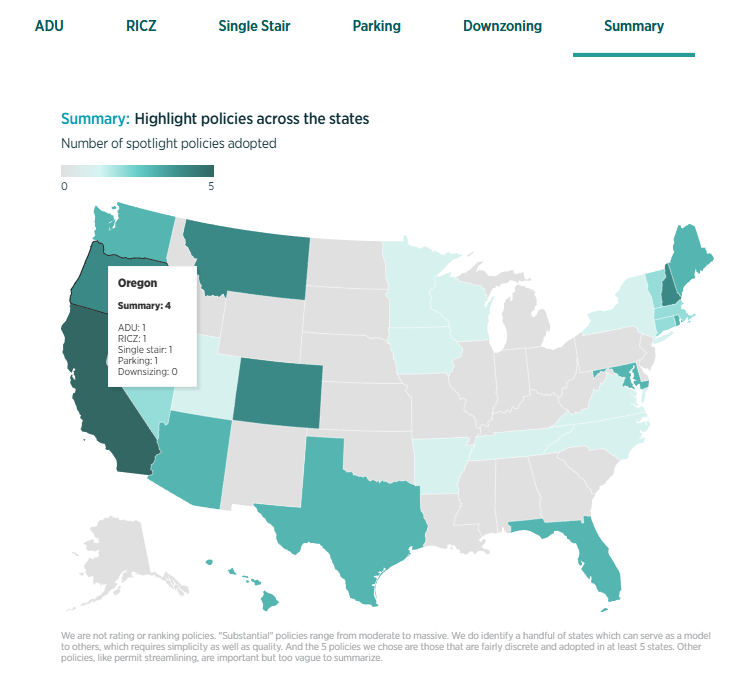
With a hugely productive legislative season in 2025, pro-homes legislators are rapidly taking good ideas around the country. To keep track of it all, my team created a new set of interactive maps. You can see snapshots here: Our goal…
In my last post I critiqued the introduction to Lynn Ellsworth’s new anti-YIMBY book, Wonder City. Having just finished Chapter 1, I thought I would add my thoughts. Ellsworth seems to be primarily motivated by a fear of something called…
Every so often I read a ringing defense of anti-housing, anti-development politics. Someone on my new urbanist listserv recommended an article by Lynn Ellsworth, a homeowner in one of New York’s rich neighborhoods who has devoted her life to (as she…
Two Substacks this week suggest that YIMBYism will or should merge with broader urbanist concerns to become something more like a political party. Two professors aligned with YIMBYism – Chris Elmendorf and David Schleicher – argue that YIMBY needs a…
I recently saw a tweet complaining that left-wing YIMBYs favored urban containment- a strategy of limiting suburban sprawl by prohibiting new housing at the outer edge of a metropolitan area. (Portland’s urban growth boundaries, I think, are the most widely…
Check out Dan Bertolet’s review of the productive legislative year in Washington, where lawmakers preempted local parking, design, and unfunded inclusionary zoning requirements, among other things.
walkable suburbs have as many children as more typical suburbs
A review of a book that endorses more flexible zoning, but doesn't reject zoning entirely.
In New York City, one common argument against congestion pricing (or in fact, against any policy designed to further the interests of anyone outside an automobile) is that because outer borough residents are all car-dependent suburbanites, only Manhattanites would benefit. For example, film critic John Podhoretz tweeted: “Yeah, nothing easier that taking the subway from Soundview or Gravesend or Valley Stream.” Evidently, Podhoretz thinks these three areas are indistinguishable from the outer edges of suburbia: places where everyone drives everywhere. But let’s examine the facts. Soundview is a neighborhood in the Southeast Bronx, a little over 8 miles from my apartment in Midtown Manhattan near the northern edge of the congestion pricing zone. There are three 6 train subway stops in Soundview: Elder Avenue, Morrison Avenue, and St. Lawrence Avenue. Soundview zip codes include 10472 and 10473. In zip code 10472* only 25.7 percent of workers drove or carpooled to work according to 2023 census data; 59.6 percent use a bus or subway, and the rest use other modes (including walking, cycling, taxis and telecommuting). 10473, the southern half of Soundview, is a bit more car-oriented- but even there only 45 percent of workers drive alone or carpool. 41 percent of 10473 workers use public transit- still a pretty large minority by American standards, and more than any American city outside New York. In the two zip codes combined there are just 45,131 occupied housing units, and 24,094 (or 53 percent) don’t have a vehicle. In other words, not only do most Soundview residents not drive to work, most don’t even own a car. Gravesend, at the outer edge of Brooklyn over 12 miles from my apartment, is served by three subway stops on the F train alone: Avenue P, Avenue U and Avenue X. It is also served by […]
We identified large 91 cities and counties that regularly fail to report their building permits to the Census Bureau - including some surprising culprits.