Physical Address
304 North Cardinal St.
Dorchester Center, MA 02124
Physical Address
304 North Cardinal St.
Dorchester Center, MA 02124

Liberalizing Cities
From The Ground Up
Autonomous vehicles will cause a congestion apocalypse on downtown streets unless we price their use of the roads.
The goal of congestion pricing is not to penalize car trips but to smooth demand over a more extended time to reduce congestion. Unfortunately, many new congestion pricing schemes seem designed to ban cars rather than manage demand for car trips. This article appeared originally in Caos Planejado and is reprinted here with the publisher’s permission. Congestion pricing aims to reduce demand for peak-hour car trips by charging vehicles entering the city center when roads are the most congested. Charging rent for the use of roads is consistent with a fundamental principle of economics: when the price of a good or service increases, demand for it decreases. Charging different rates depending on the congestion level spreads trip demand over a longer period than the traditional peak hour. The goal of congestion pricing is not to penalize car trips but to smooth demand over a more extended time to reduce congestion. Unfortunately, many new congestion pricing schemes seem designed to ban cars rather than manage demand for car trips. Congestion pricing then becomes more akin to the “sin taxes” imposed on the consumption of tobacco and alcohol than to traffic management. The traffic on urban roads in a downtown area is not uniform during the day but is subject to rush hour peaks, while late-night road networks are usually underused. The use of roads in the downtown area is similar to other places like hotels in resort towns. Hotels try to spread demand away from peak season by reducing prices when demand is low and increasing prices when demand is high. When resort hotels charge higher prices during weekends and vacations, it is not to discourage demand but to spread demand over a broader period. Well-conceived congestion pricing for urban roads works under the same principles as the pricing of hotels. […]
Marcos Paulo Schlickmann, a transportation specialist and collaborator at Caos Planejado, our Brazilian partner website, recently interviewed Professor Donald Shoup, who answered questions about private and public parking issues. Private parking Marcos Paulo Schlickmann: What is your opinion on legal parking minimums? Donald Shoup: In The High Cost of Free Parking, which the American Planning Association published in 2005, I argued that minimum parking requirements subsidize cars, increase traffic congestion, pollute the air, encourage sprawl, increase housing costs, degrade urban design, prevent walkability, damage the economy, and penalize poor people. Since then, to my knowledge, no member of the planning profession has argued that parking requirements do not cause these harmful effects. Instead, a flood of recent research has shown they do cause these harmful effects. Parking requirements in zoning ordinances are poisoning our cities with too much parking. Minimum parking requirements are a fertility drug for cars. MPS: What would happen if we were to abandon parking minimums? DS: Reform is difficult because parking requirements don’t exist without a reason. If on-street parking is free, removing off-street parking requirements will overcrowd the on-street parking and everyone will complain. Therefore, to distill 800 pages of The High Cost of Free Parking into three bullet points, I recommend three parking reforms that can improve cities, the economy, and the environment: Remove off-street parking requirements. Developers and businesses can then decide how many parking spaces to provide for their customers. Charge the right prices for on-street parking. The right prices are the lowest prices that will leave one or two open spaces on each block, so there will be no parking shortages. Prices will balance the demand and supply for on-street parking spaces. Spend the parking revenue to improve public services on the metered streets. If everybody sees their meter money at work, the new public services can […]
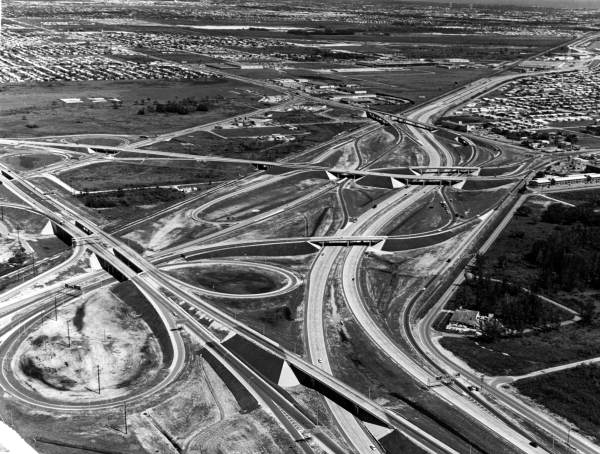
Surprise!! I’ve had the intent to wrap-up the Rothbard The Urbanist series for a long time, and it’s been sitting on my todo list for over 6 years. I want to thank Jeffrey Tucker, then at mises.org, and now at FEE.org and liberty.me for enthusiastically granting permission to reprint excerpts from For A New Liberty. Murray Rothbard’s 1973 classic can be downloaded free from Mises.org as pdf, and audio book read by Jeff Riggenbach. This chapter is also discussed by Bryan Caplan as part of an econlog book club series on For A New Liberty. It’s been a while, so you may want to catch up on the first six posts: Rothbard the Urbanist Part 1: Public Education’s Role in Sprawl and Exclusion Rothbard the Urbanist Part 2: Safe Streets Rothbard the Urbanist Part 3: Prevention of Blockades Rothbard the Urbanist Part 4: Policing Rothbard the Urbanist Part 5: Diversity and Discrimination Rothbard The Urbanist Part 6: Traffic Control We pick up in the heart of chapter 11: “The Public Sector, II: Streets and Roads” to expand on a subject core to Market Urbanism: the pricing of highways, and the consequences of a system where politics, special interests, and top-down planning have incarnated a dysfunctional system severely disconnected with bottom-up pricing signals necessary to be sustainable. Tragically, Rothbard’s insights on these subjects have been mostly neglected for over 30 years, while apologists for sprawl and automobile dominance have nearly monopolized the conversation among free-market advocates. We begin the section with Professor Rothbard’s acknowledgement of what sprawl apologists turn a blind eye to, yet urbanists on the left are keenly aware. Government intervention, fueled by special interests and old-fashioned progressive ideology, massively subsidized the highway system and crowded-out otherwise viable railroads. As a result, we have an overbuilt highway system, urban neighborhoods were eviscerated, suburbs spread far-and-wide, privately […]
Peter Gordon blogs about a paper he presented at the Transportation Research Board conference in DC: My friends and I just presented this paper at the Transportation Research Board meetings in Washington DC. We tested the effects of tolling Los Angeles’ freeways in the peak hours (we tested 10 cents and 30 cents per mile). It’s a simulation on a real network and many substitutions occur. As expected, peak-hour freeway speeds increase, some people switch to surface streets and that traffic slows, some switch to off-peak hours and some (very few) travel less. And politicians take in a lot of money! That’s for the 10-cent toll. The 30-cent toll overloads the surface streets. Many other options can be tested, including only tolling some of the freeways. Planners have voiced concern that tolling the freeways would overload surface streets. There is probably a “sweet spot” that can easily be found. We also plan to look for effects on freight travel as well as travel by income groups. He’s established that “very few” people lessen their travel. And if the the number of people who switch to off-peak hours is small compared to the number of people who move to surface streets (and judging from my very cursory perusal of the paper, it seems like this is the case), then tolling is just shifting the burden from highways to local roads. This could be a problem since local roads, unlike highways, are paid for almost entirely out of general revenue, not user fees. It seems like the rational thing to do at this point is to argue for tolling local surface streets as well, perhaps through a congestion charge. Maybe I missed it (like I said, I didn’t read the presentation paper thoroughly), but his talk of a “sweet spot” in the summary […]
The New York Daily News broke the story yesterday that New York lawmakers are once again trying to push congestion pricing through the state legislature, a task at which Mayor Michael Bloomberg failed in 2008 after meeting fierce resistance from outer borough and suburban drivers. Learning from his previous failed bid to charge drivers $8/day to enter Manhattan below 60th Street, the plan is being rebranded as “traffic pricing” and will be linked to payroll tax relief for those outside the five boroughs in an attempt to win the support of suburban legislators who torpedoed the 2008 proposal. Despite being the most transit-saturated city in America, New York City drivers have had free reign of its surface streets since the days when they were maintained by private streetcar companies. Unlike highway users and transit riders, drivers have never been asked to pay a penny in direct fees for the local roads they use. This has created generations of Americans who feel entitled to freeride on the backs of their poorer, car-less fellow citizens, which has made congestion pricing one of Bloomberg’s rare failures during his decade-long tenure as mayor. New York State Senate Majority Leader Dean Skelos (R-Nassau County) calls it “just another tax,” but it differs from a general tax in one critical way: It is levied solely on those who drive in Manhattan, meaning that it does not redistribute wealth from those who don’t use the roads to those who do. And while the accounting costs for modes of transportation are subsidized to some extent, roads have enormous opportunity costs—far higher than transit, which uses relatively marginal underground land and has a minuscule footprint relative to paved roads. Land is extremely expensive in New York City, so these opportunity costs are larger than they might be out in […]
1. Laneway housing, Vancouver vs. Toronto. 2. New York state lawmakers want to ban using a phone or listening to headphones while crossing streets. Unfortunately for us pedestrians, there are very few limited access, grade-separated walkways, so in essence this would criminalize listening to an iPod while walking. 3. An interesting article about transportation in Singapore, with an emphasis on congestion pricing and other ways of recouping the enormous opportunity costs of urban roads. 4. I’ve been aware of this for a while, but it still shocks me every time (emphasis mine): We know New Yorkers are being injured and killed just about every day. (Like the 35-year-old woman who was run over by a dump truck on the Upper East Side Monday while legally crossing the street. Did you hear about that one? The dump truck driver stayed at the scene and wasn’t drunk, so it was basically a freebie for him — a clean, legal kill as far as the NYPD is concerned. Can you imagine if she were your wife or sister or colleague? Anyway… back to those damned bikes, right?…) 5. Yet another example of why I don’t think the Texas Transportation Institute’s congestion metrics are useful. 6. As if we needed any more proof: Big cities are inherently green.
It’s already Sunday and I’ve exhausted my cache of unread blog posts from the week, so I went in search of new blogs to read and can across this really good one: Spatial Analysis. A post from December has this set of maps – private turnpikes in 18th century London and the congestion zone map in the 21st: It looks to me like the old map is skewed and that they are actually quite similar, but I’m having trouble aligning them – maybe someone who knows London better than me could compare them for us? Again, that’s from spatialanalysis.co.uk.
Expect a lot more of these… 1. Beijing tries to relieve congestion by…building a quarter-million parking new spaces and 125 miles of new downtown streets?! But don’t worry – bike sharing! 2. Seattle inches closer to a Shoupian on-street parking policy, and Austin ponders charging for on-street parking after dark and on Saturdays. My favorite comment from the Seattle story is this one: “Get rid of the illegal aliens and we will have LOTS of room to park! And plenty money! Sanctuary idiots!” I guess that was one positive aspect of the Holocaust: more parking! (Oops, did I just Godwin this blog?) 3. East (a.k.a. Spanish) Harlem wants to develop its transit-accessible parking lots and fill them with “low- and middle-income residents” to aid in its “struggl[e] to maintain its affordable housing stock,” but of course “they want to prevent the construction of large apartment towers.” Sorry, East Harlem – you can’t have your cake and eat it too. 4. As if we needed any more evidence that diverting police officers for voluntary bag searches in the DC Metro was an absurd idea. 5. A Green candidate for London mayor has proposed expanding the area that the congestion charge covers, build tiers in, and raise prices to the point where entering the innermost part of London would cost drivers £50/day (!!). As long as we don’t end up on the right-hand side of the Laffer curve – that is, as long as the city can raise more revenue at £50/day than it could at any lower price – I think this would be a step in the direction of market urbanism, since it would emulate the behavior of a profit-seeking road firm. (One way of testing that is to raise the charge gradually and to stop once total revenue starts […]
One of the sickest paradoxes in American law has got to be the arduous environmental review that’s applied to transit and dense building projects, but I didn’t think it was this bad. From an article about San Mateo County residents bitching about being asked to pitch in for the roads they use: The earliest the city could set up congestion pricing would be 2015, after a lengthy environmental review process. Note that except for maybe a few toll booths or, more likely, cameras, a congestion charge doesn’t require any new construction. I’m really curious as to what statute makes such an absurd environmental review necessary – any readers care to take a guess?