Physical Address
304 North Cardinal St.
Dorchester Center, MA 02124
Physical Address
304 North Cardinal St.
Dorchester Center, MA 02124

Liberalizing Cities
From The Ground Up
In 2015, urban studies professor Anne Haila published a book on Singapore’s land ownership and housing system called Urban Land Rent: Singapore as a Property State. The Singapore housing model has recently been getting some attention for its widespread homeownership and affordability relative to high-cost coastal cities in the United States. Both Haila and, recently, writers at Bloomberg and CityLab approach Singapore uncritically. And Singapore’s housing market does offer some key lessons to the United States. But unlike the story Haila and some other U.S. commentators have told, it has its downsides. Singapore’s housing market works much better for households near the middle of its income distribution relative to the highest-cost U.S. regions, but provides severely inadequate housing for its low-income migrant workers. The Mechanics of Singapore’s Public Housing In Singapore, 90% of the land is government-owned, and about 80% of citizens and legal residents live in owner-occupied public housing on leased land. Extensive government landholdings and a leasehold system date back to the country’s colonial era. Following Singaporean independence in 1965, the People’s Action Party, which has been in power ever since, has expanded state land holdings. At independence, about 50% of Singapore was government-owned, reaching its current level of holdings in 2002. Government land ownership has been accomplished through eminent domain along with land reclamation, which has increased the size of the island by a quarter. Government land is auctioned for housing and other types of development primarily as 99-year leases. The Housing and Development Board (HDB), a government agency, builds the majority of new housing, but some higher-end housing is privately developed. The HDB and private developers compete for land at auctions, and both pay market prices for it. Unlike the U.S. public housing system under which units remain government-owned and are leased to low-income tenants, Singapore’s […]
One common argument against new housing is that it will turn “[neighborhood at issue] into Dubai.” Evidently, some people think Dubai is a hellscape of super-dense skyscapers. In fact, Many Dubai neighborhoods aren’t very dense at all. There is one Dubai neighborhood that is more dense than most urban neighborhoods in North America: Ayal Nasir (which has about 200,000 people per square mile). But it looks far more like Paris than the popular stereotype of Dubai: streets are narrow, and most buildings are five or so stories high. The neighborhood next door, Al Murar, has 130,000 people per square mile and has a similarly human-scale urban fabric.

Zoning regulations inflict great harm. But it is difficult for Americans to imagine the cost of zoning in Indian cities. Delhi is one of the most crowded cities in the world, and there is great demand for floor space. But real estate developers are not allowed to build tall buildings.

Over the past few years, Japanese zoning has become popular among YIMBYs thanks to a classic blog post by Urban kchoze. It’s easy to see why: Japanese zoning is relatively liberal, with few bulk and density controls, limited use segregation, and no regulatory distinction between apartments and single-family homes. Most development in Japan happens “as-of-right,” meaning that securing permits doesn’t require a lengthy review process. Taken as a whole, Japan’s zoning system makes it easy to build walkable, mixed-use neighborhoods, which is why cities like Tokyo are among the most affordable in the developed world. But praise for Japanese zoning skirts an important meta question: Why did U.S. zoning end up so much more restrictive than Japanese zoning? To frame the puzzle a different way, why did U.S. and Japanese land-use regulation—which both started off quite liberal—diverge so dramatically in terms of restrictiveness? I will suggest three factors; the first two set out the “why” for restrictive zoning and the third sets out the “how.” Any YIMBY efforts to liberalize cities in the long term must address these three factors. First, the U.S. privileges real estate as an investment where Japan does not, incentivizing voters to prohibit new supply with restrictive zoning. Second, most public services in the U.S. are administered at the local level, driving local residents to use exclusionary zoning to “preserve” public service quality. Third, the U.S. practice of near-total deference to local land-use planning and widespread use of discretionary permitting creates a system in which local special interests can capture zoning regulation and remake it around their interests. At the outset, why might Americans voters demand stricter zoning than their Japanese counterparts? One possibility is that they are trying to preserve the value of their only meaningful asset: their home. In the U.S., we use housing […]
While reading someone else’s work, I recently ran across an article by David Cay Johnston of the New York Times, claiming that overseas oligarchs turning apartments all over the world into unused “ghost apartments”. In this article, Johnston writes: “In Paris, for instance, one apartment in four sits empty most of the time.” This claim struck me as so astonishing that as to be implausible, for the simple reason that in other “global” cities vacancy rates are much lower. For example, in New York only 9 percent of housing units are vacant, and most of those units are currently for sale or rent.* Even this vacancy level should not be particularly astonishing, since cheaper American cities often have higher vacancy rates. For example, Houston has an 11 percent vacancy rate, and Atlanta has an 18 percent vacancy rate. After googling “one in four paris apartments vacant” I found an article claiming that 26 percent of apartments in four Paris arrondisements (neighborhoods) is vacant- a much narrower claim, comparable to an assertion that one in four midtown Manhattan apartments is vacant. One would think that a journalist as distinguished as Johnston would know the difference between “Paris” and “some parts of Paris.” A more recent article claims that only 7.5 percent of Paris apartments are vacant- a lower vacancy rate than that of New York. Moreover, we don’t know what the local media means by “vacant.” Does this category limited to apartments that are unused 365 days a year? What about units that are rented out now and then through Airbnb? Or units that are currently being advertised for rent or sale? I suspect that the true number of “ghost apartments” is far lower than 7.5 percent, since in London (another “global city”) less than 1 percent of housing units are […]

Alain Bertaud’s long awaited book, Order Without Design: How Markets Shape Cities, is out today. Bertaud is a senior research scholar at the NYU Marron Institute of Urban Management and former principle urban planner at the World Bank. Working through a pre-release copy over the past few weeks, I can confidently say that the book is an instant classic of the urban planning genre, and will be of significant special interest to market urbanists in particular. Rare among writers in this space, Bertaud brings an architect’s eye, an economist’s mind, and a planner’s experience to contemporary urban issues, producing a text that is theoretically enriching and practically useful. Alain and Marie-Agnes—his wife and research partner—have lived in worked in over a half-dozen cities all over the world, from Sana’a to Paris to San Salvador to Bangkok. For the reader, this means that Bertaud can speak from experience, supplementing data and theory with entertaining, real world examples and war stories. Order your copy today!
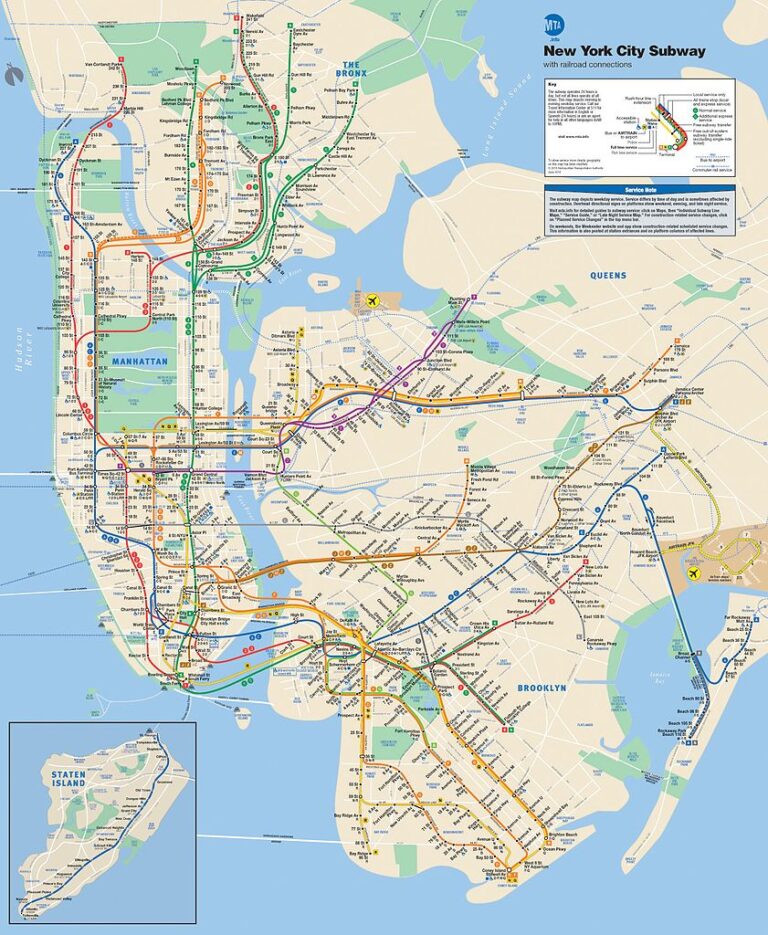
This year, for the first time since 1979, New York City has revamped its subway map. A quick glance shows a change in the background tinge from light tan to light green – most pleasant. To my relief, however, on closer inspection nothing essential has changed from the last version. Thank goodness it still doesn’t look anything like the map of London’s Underground. London’s map has been touted as the path-breaking paradigm of subway maps, the object of widespread acclaim and imitation. Indeed, most major cities’ transit systems have adopted the map’s efficient symmetry, which was created by Harry Beck back in 1931 during the heyday of high modernism. Here it is (pdf). It’s easy to see why it has won praise. It’s beautiful, looking like a two-dimensional version of a uranium molecule or the lattice of some fantastic crystal. The same could be said for the maps of the underground systems of Paris and Tokyo. It’s about Usefulness As you’ve probably already guessed, however, I don’t like it. And it’s not about aesthetics. Here’s the problem: I’m just one person, of course (although here’s another guy who seems to agree with me), but when I’m in London I find myself constantly frustrated when I try to get from place to place using that map. The problem is that I need two maps: the Underground map to tell me how to get from, say, Paddington to Notting Hill Gate, and a street map to tell me exactly where the heck Notting Hill Gate is in relation to Paddington. The former abstracts from so much street-level detail that, unless you’re already familiar with the layout of London, the map, rather increasing the efficiency of travel via mass transit, actually makes it more cumbersome. New York City’s subway map on the other […]
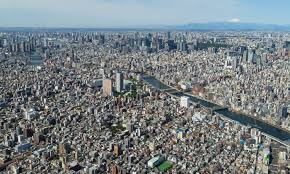
Four years ago my wife and I decided to take our son to a special and slightly unusual restaurant to celebrate his birthday. We were in Tokyo at the time and gave the taxi driver what we thought was the address for the restaurant – it had names and numbers on it. Cabbies in Tokyo, and in Japan in general, are renowned for their courtesy, the cleanliness of their cabs, and their driving skill. We were very surprised, therefore, when our driver suddenly pulled over and told us that “the restaurant is somewhere around here,” let us off, and drove away. After several minutes of search, we did manage to find the restaurant around the corner about a block or so away. We had a great meal, but the memory of that experience has always been something of a puzzle – until now. This summer we returned to Tokyo for a family vacation, and while relaxing in our hotel room I found myself thumbing through a guide book we had brought along, Japan Made Easy, in which I found this startling statement: “Tokyo … has thousands upon thousands of streets, but fewer than one hundred of them have names.” A quick check of Google Maps seems to confirm this assertion. (Hat tip to Jeremy Sapienza). More than One Way to Address a Letter This raises some obvious questions, such as how one addresses a letter. The guide says: …[T]he addressing system in Japan has nothing whatsoever to do with any street the house or building might be on or near. Addresses are based on areas rather than streets. In metropolitan areas the “address areas” start out with the city. Next comes the ku, or ward, then a smaller district called cho, and finally a still smaller section called banchi. This […]
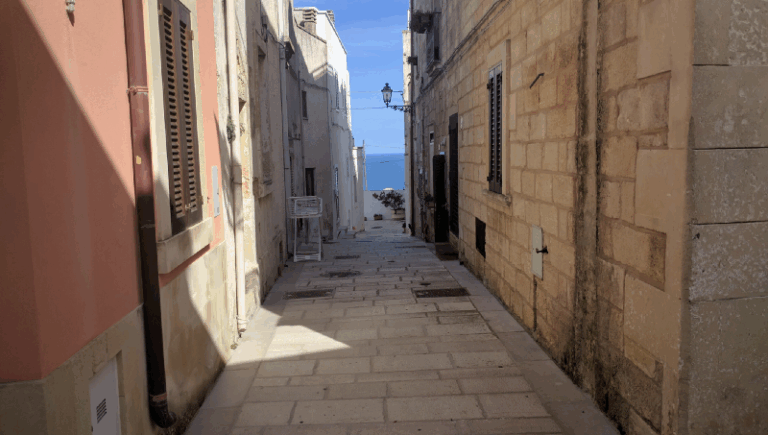
There is always the lurking suspicion that great urbanism is a museum piece, something we cannot recreate. We have to console ourselves with guarding what’s left. Even then, some feel it unfit for ‘modern life,’ that humans cannot live as their recent ancestors had. Urbanists tend to celebrate cities and spaces of great renown, which makes remaking our own little corner of the world seem futile. I spent a year living in Europe–visiting Belgium, Italy, Spain and France, among other places–and found that the best places were not the big cities, but old villages, often very wealthy in times past. And it’s easy to miss what’s special about these quiet gems: the little streets and paths within them that people call home. A newly-built mall in Leuca, Italy showcases an older design sensibility A bike tour led me to several towns in southern Italy—among them, Castro was my favorite aesthetically, with warm, immaculate streets around the center that were nonetheless devoid of many people. Castro, Italy Castro, Italy Long before going to Europe, I had seen this meme photo: Lo and behold, one such camera appeared right above where I parked my bike. But overall, Bari’s old city was my favorite, with all the life coarsing through its streets. Families would open their doors and put out folding chairs in the streets. They made the streets their living room, while literally airing their dirty laundry in the rafters between buildings. Bari, Italy A quiet street in Leuven, Belgium—perhaps my favorite of all A Flemish parking lot—the Grand Beguinage, Leuven, Belgium Reims, France In Reims, I got to tour some underground cellars that formerly stored champagne. With cool temperatures, high ceilings and lush moss lining the walls, I thought—I’d love to live here! Should people be banned from […]
As an economics professor, I often witness the surprise of my students when I explain how something as important as the market for food or clothing is self-regulating. True, there are quality and safety regulations that attempt to control potential hazards “around the edges” of these vital markets, but by far the heavy lifting is done by competition among rival firms in the same industry. Trying to sell tainted food or shoddy clothing in a competitive market without special privileges will either put you out of business or make you very quick on your feet. And I get great satisfaction when I see students realize that advertising, free entry, and entrepreneurship, in the context of economic freedom, are what keep goods and services safe, cheap, and of good quality. Witness what happens when drugs and prostitution are prohibited: overly concentrated, dangerously mixed narcotics and significantly higher rates of sexually transmitted diseases, both accompanied by violence and corruption. Here government intervention thwarts self-regulation. The Nonmarket Foundations of the Market Process In the past dozen years or so, as a result of my research interest in the economy of cities, which was sparked by my discovery of the writings of Jane Jacobs, I’ve come to appreciate more and more the nonmarket foundations of the market process. Some of this has been reflected in previous Wabi-sabi columns that were concerned with social networks (most recently last week but also here). Without norms that say, for example, treating strangers fairly and trading with them is good, or that lying to and stealing from strangers is bad, human well-being couldn’t have soared to the heights of the past 200 years, especially the last 60. Now obviously none of this would have happened either without the widespread acceptance of private property, freedom of association, and the […]