Physical Address
304 North Cardinal St.
Dorchester Center, MA 02124
Physical Address
304 North Cardinal St.
Dorchester Center, MA 02124

Liberalizing Cities
From The Ground Up
I recently spoke with George Mason University Law Professor David Schleicher about his research on land use law and economics. Here is our conversation including links to some of his academic articles that have earned a lot of attention in the land use blogosphere. Emily: What are some the costs of land use restrictions? Talk about agglomeration economies and how these relate to development restrictions. David: This is a huge area of research that spans back to Alfred Marshall looking at why cities exist in the first place. It comes up with explanations for why people are willing to pay increased rents to live downtown. These include lower transportation costs for goods, which was a major driver of urbanization for much of American history. Today this is a small driver of urbanization because the costs of internal shipping have fallen so dramatically. Now an important advantage of urbanization is market size. You can see this in all different markets. Restaurant rows are a great example of this. When you go to one of these rows where there are a lot of restaurants and bars, you have insurance that if one place you go is bad, you know you have other options nearby. The last category of agglomeration benefits is learning, or information spillovers. We see this in cluster economies like Silicon Valley where people at different firms learn from each other. As Marshall explained, “The mysteries of the trade become no mysteries, but are as it were in the air.” Wage growth is faster in urban areas than in rural areas, and this comes from this learning process. In the aggregate, if you keep people out of dense cities, you will decrease national productivity. Emily: In your paper City Unplanning, you propose a tool called Tax Increment Local Transfers (TILTs) that would compensate property owners for allowing more development […]
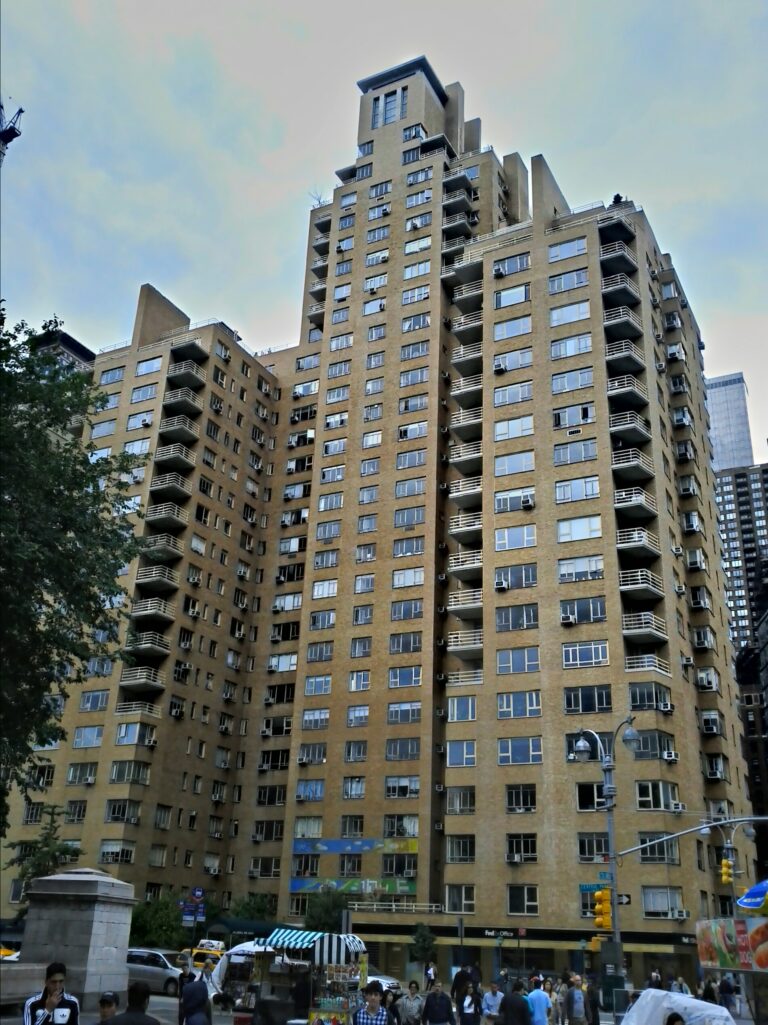
It sounds like a dumb question – they exist because people like the security of owning a home combined with the services and lower costs that apartments offer, duh! But upon further reflection, condominium-style tenure can be a bit problematic. The main problem, as I see it, is that a building that’s been carved up into condo units can almost never be redeveloped. So much so that preservationists have been known to cheer on developers doing condo and co-op conversions of historic properties: Indeed, sometimes preservation advocates look to condo developers as white knights. Since the Bialystoker Center for Nursing and Rehabilitation on East Broadway closed last year, Laurie Tobias Cohen, the executive director of the Lower East Side Jewish Conservancy, has been “extremely eager” for a developer to buy the historic building and convert it to co-ops or condos. The closing of the nursing home was a great loss, she said; the goal now is to prevent the demolition, or further deterioration, of the building. “What we don’t want,” she said, “is to lose any more of the built historic fabric.” This is no doubt an elegant solution to the problem of unprotected historic buildings, but what about the less-than-stunning condos and co-ops that have been built in the US – and pretty much every where else in the world! – since the end of World War II? Why are condo buildings impossible to redevelop? Simple: gravity! You can’t keep your apartment on the 17th floor while someone demolishes their 5th floor unit. In Canada, Australia, New Zealand, and Singapore, they call condos “strata” apartments, which reflects what they really are: floors of apartments layered inseparably atop each other. To redevelop a condo or co-op building, you have to buy every single unit, after which you can dissolve the condo structure […]
At Discovering Urbanism, Daniel Nairn offers an interesting summary of Edward Murray Bassett’s 1922 defense of zoning (available as a free e-book). Bassett faced opponents who were against a new type of land use regulation, many arguing that zoning was unconstitutional. In retrospect, some of his arguments defending zoning are comical. He asserts that zoning would never go so far as to direct aesthetics because the courts would protect us from the overreach. It would be interesting to hear what he’d have to say about a planning commission meeting today. Nairn’s entire analysis is interesting, but I was particularly intrigued by Bassett’s assertion that zoning fosters cooperation. As Nairn summarizes: Cooperation yields overall larger return on investment for all property owners. This was Bassett’s primary concern, one that he underscored with a number of prisoners’ dilemma scenarios. For example, “In some of the larger cities a landowner in the business district is almost compelled to put up a skyscraper because if he put up a low building, his next neighbor would put up a higher one that would take advantage of his light and air.” He asserted that skyscrapers were probably not a sound investment in their own right, but they were built anyway in a virtual arms race for public goods of light, air, privacy, and scenery. Zoning was the truce that made everyone better off. I’m not sure that I follow Bassett’s logic here. If light and air are only available on floors that are higher than the floors of the neighboring buildings, then only the top few floors of any building would typically have this asset. It’s almost as if he’s talking about a race to the highest roof deck here. Aside from the problems with how he makes this argument, it is worth a look to determine […]
Among Egypt’s pro-democracy protesters, graffiti has played an important role in the communication, providing a platform for free speech under military rule. The Associated Press reports: Graffiti has turned into perhaps the most fertile artistic expression of Egypt’s uprising, shifting rapidly to keep up with events. Faces of protesters killed or arrested in crackdowns are common subjects — and as soon as a new one falls, his face is ubiquitous nearly the next day. The face of Khaled Said, a young man whose beating death at the hands of police officers in 2010 helped fuel the anti-Mubarak uprising, even appeared briefly on the walls of the Interior Ministry, the daunting security headquarters that few would dare even approach in the past. Other pieces mock members of the Supreme Council of the Armed Forces, the council of generals that is now in power, or figures from Mubarak’s regime. While this artistic movement in the Arab Spring puts the importance of freedom of expression in sharp relief, we of course more typically see graffiti and street art in freer societies where the act is often seen not as political uprising but as mindless vandalism. As a big believer in the power of property rights, I feel like I should be against street art as clear violations of building owners’ rights. However, it’s hard to argue that illegal street art doesn’t add something valuable to cities both visually and culturally, in times of peace as well as times of civil uprising. It would be nice to suggest that a signalling mechanism could show artists on which buildings their work is permissible, but, not knowing much about the culture of street art or graffiti, I imagine that decriminalizing this art form would destroy it. What do you all think of unsanctioned street art? Does it make […]
Pretty interesting article in the NYT today about the Gotham West development that recently broke ground on Manhattan‘s far west side. But I think the part about affordable housing could use some context: But the bulk of the project will be affordable units, 682 of them, or more than half the total homes….
There’s been a lot of handwringing by American lefties over the austerity plans that Germany is asking indebted eurozone governments like Italy and Greece to implement in exchange for bailouts, but many aspects of the plans – especially labor market deregulation – are long overdue no matter which side if the aisle you sit on (in the US, at least). In searching for information on the deregulatory aspects of Prime Minister Mario Monti’s “Save Italy” austerity plan, I came upon this interesting bit on transport deregulation in Corriere della Sera. I’ve never actually studied or spoken Italian, but hopefully this is a workable translation, if a bit literal: The recipe that the Antitrust Authority has chosen for taxi liberalization will double the number of licenses, but with each driver receiving a second one as compensation….
On a recent post about property rights in the land market, commenter David Sucher brought up the issue of transaction costs. He commented here and at his blog City Comforts: The “least intrusive means” should be always kept in mind. The only issue for me is the huge transaction costs which, I believe, make private agreements for land use quite impossible. The very reason we have government is because “voluntary private contracts” are too complex. We got rid of tort law (as to land use) because it was much easier to have uniform area-wide regulations. While David brings up very valid points, I think that economist Ronald Coase offered a persuasive argument against these area-wide regulations. The Coase Theorem, which interestingly, I don’t think we’ve written about in depth here, addresses this issue of transaction costs. In 1960, Coase published his most famous paper, “The Problem of Social Cost,” exploring a common problem for city dwellers: annoyance at their neighbors’ behavior. Coase uses as an example a confectioner whose business is adjacent to a doctors office. The confectioner uses loud machinery which causes vibrations next door and bothers the doctor. We can imagine a variety of solutions to this problem: the doctor could sound proof his office, the confectioner could upgrade to quieter machinery, one of them could move his business, the confectioner could compensate the doctor for the bother, or the doctor could pay the confectioner to stop making noise during his business hours. Assigning property rights would help any of these solutions emerge; if the confectioner has a right to make noise, the responsibility lies with the doctor to remedy the situation (or learn to live with the noise) or the reverse if the doctor has a right to quiet. In a standard Micro 101 class, in my experience, the […]
It has often been suggested that one of the reasons that American subway construction is so expensive is that our laws are too friendly to NIMBYs. That is to say, contractors will be paid to engineer expensive, long-term solutions to avoid short-term disruptions to neighbors during construction. The most prominent example is avoiding cut-and-cover subway construction in favor of digging deep holes with tunnel boring machines that don’t disrupt the surface as much. …
"Made in USA"…and don't you forget it! United Streetcar, led by its former lobbyist, Chandra Brown, is ostensibly a manufacturer, though its greatest asset seems to be its ability to win government contractors….
From an interesting NYT analysis of Russia’s new protesting class – young, urban, and doing pretty well: It is a paradox, but one that has been documented by social scientists: the residents of Moscow and other large cities tend to express greater frustration with Prime Minister Putin as his government has helped make them wealthier. One explanation is the high level of public corruption here, which threatens new personal wealth….