Physical Address
304 North Cardinal St.
Dorchester Center, MA 02124
Physical Address
304 North Cardinal St.
Dorchester Center, MA 02124

Liberalizing Cities
From The Ground Up

My favorite conference of the year is always the Urban Economics Association annual meeting, which is small, collegial, and technical. In 2024 and 2025, I published my notes on interesting papers. I think I went a little overboard this year and included virtually every paper I saw presented (plus a few I didn’t). The result is 25 blurbs this year, compared to 13 in each of the first two! It’s a very helpful aide-memoir for me – and hopefully for others, either directly or via LLMs.
Some of the best papers in my notes resisted categorization:
Lu Han (presenting), Rachel Ngai and Kevin Sheedy presented a nice model that helps explain the Current Moment in housing cost. When the Fed increased interest rates sharply to curb inflation in 2022, that made homebuying relatively less attractive than renting. That change decreases prices but increases rents. Here’s a slide showing the change from an earlier presentation:
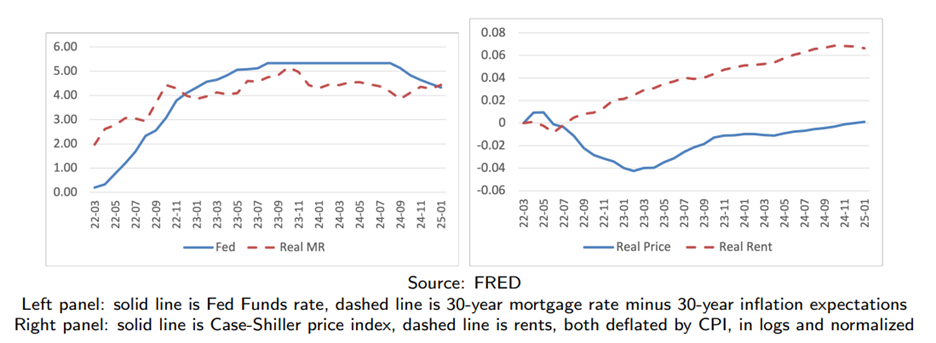
But the authors find that a model with few frictions can’t explain this change. Instead, they need rental search frictions, which allows the lessor to capture more of the surplus when there are more apartment-seekers chasing each vacancy. For renters, when it rains, it pours.
Buy-to-rent investors play a mitigating role in this framework, shifting some properties from ownership to rental. Too bad federal and state governments are trying to shut them down.
Yurou He presented a clever job-market paper with good theoretical and empirical contributions. Land assembly for redevelopment creates a surplus that each seller would like to extract. In particular, she used the layout of the parcels to identify “pivotal” parcels, which are indispensable to the geometry of the assembly. A very curious fact, which she didn’t spend time on, is that assemblies with either 0 or 2 pivotal parcels are very common; assemblies with 1 are very uncommon. I’m not sure if that’s a boring artifact of parcel geometry or a fascinating artifact of multiplayer bargaining games – it would be good to know.
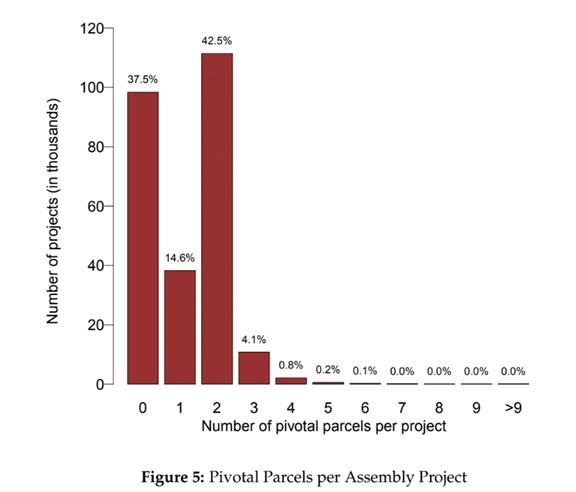
As theory predicts, the sellers of the pivotal parcels (only) are able to command above-market prices during assembly.
(The one aspect of the project where I remained unsure was whether she had reliably captured cases where the assembler hides behind various shadow buyers to prevent bargaining, which seems like the obvious move.)
Micah Baum won the student prize with his paper on the social consequences of Houston’s minimum lot size reduction. He looked at the outcomes for children who lived in neighborhoods where small-lot homes were allowed (he errantly calls this area “downtown”; it’s geographically larger than the entirety of DC, Boston, SF, or Manhattan). To do this impressive study, he uses individual-level Census Data.
One thing this allows him to do is directly characterize the 20,000 households that moved into the new small-lot houses:
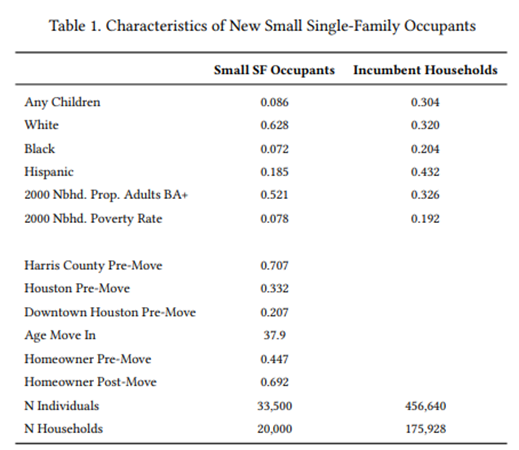
In the affected neighborhoods, children of incumbent homeowners came out way ahead: they stayed in place, experienced improving neighborhoods, stayed in school, and benefited from higher parental housing wealth. Renters’ children, by contrast, were more likely to move out of central Houston. Although their new neighborhoods were no worse, they suffered some costs of disruption and had worse life outcomes.
Although the net benefits outweigh the costs, Baum finds, there is no easy way for the winners to compensate the losers. But even if that’s true, it’s not unique. Social life in any system (capitalist, socialist, corporatist, whatever) is shot through with non-Paretian tradeoffs. Developed-world cities and nations today use progressive taxation and public goods provision as a means to roughly net out the millions of little pros and cons. The degree may be too low or too high, and surely some individuals come out way ahead, but it’s not as though non-Paretian efficiency gains are unique to upzoning.
The most surprising paper of the conference was from Yuki Kanayama (presenting) and Taisuke Sadayuki, who look at the causes and consequences of housing dereliction in Toshima City, Tokyo. Kanayama confirmed that even today, when 30-year-old houses have relatively high quality, Japanese buyers are uninterested in used housing. So there’s a steady supply of old houses going to seed. The authors use decades-old road plans as an instrument to define treatment and control groups: if owners think that upzoning or eminent domain might someday come along, they’re more willing to sit on derelict properties. So far, no surprises.
More surprising: the presence of a derelict house really drags down local rents. A single derelict lowers rent within 80m by 1.6%.
But here’s the real surprise: The rent cost of a derelict house is much larger (more like -5%) for rentals that are “far” from a police koban or fire station.
How far is far? That’s the biggest surprise: the median distances from police and fire are 300m and 500m. If this is true, Japanese people are really uncomfortable living more than 5 minutes’ walk from police and fire service.
Chatting after the presentation, Kanayama said that friends’ anecdotes support this view: they check the distance from emergency services before renting. I don’t think I’ve ever heard an American friend mention fire and police proximity as a pro or con.

Filip Sangild Beck, David Jinkins (presenting), and Ismir Mulalic look at the role of public housing in a rapidly gentrifying city: Copenhagen. True to stereotype, public housing in Denmark is abundant (20% of the stock), desirable, and not particularly targeted toward the poor. The American presenter told us he’d signed up his Danish-born child on the waiting list.
The authors’ question is an ideal case for using a QSM: how would Copenhagen be different if it changed its public housing policies? They find that
The bigger point is that we now have the tools to evaluate the equilibrium effects of complicated policy changes, including consequences like relocation of workplaces.
John Mondragon presented work with Schuyler Louie, Rami Najjar, and Johannes Wieland – but not the controversial paper you’re thinking of. This is a newer investigation that attempts the difficult task of harmonizing housing costs and consumption across countries. He presented 5 “stylized facts” about housing across the development cycle:
To my reading, there’s nothing in these facts that is serious evidence for or against an important role for regulation.
They interpret the facts, though, as in their earlier paper, as evidence that, above some level of income, demand for the number of housing units is satiated, but demand for quality keeps rising. The problem with making this the central story about housing cost is that, within developed countries, people in the most expensive cities live in the smallest, crappiest dwellings.
One minor point: they really need to switch from using people in the denominator to adults.
Hans Manner, Ferdinand Rauch, and Martin Schlesinger (presenting) had an alluring title: the Industrialization of the Alps. It is a great question, indeed, why the northern slopes of the Alps are currently the highest-income region in Europe, across multiple national and linguistic borders. These areas were marginal to the Roman Empire, difficult to reach by water transport, and mostly irrelevant in the Middle Ages.
Sadly, this paper didn’t tell us any of that. Instead, it was a within-region comparison of a single Austrian province (Styria). Places with coal industrialized first. Early electrification was somewhat random but generated permanent gains.
Nate Baum-Snow (presenting) and Daniel Hartley (according to my notes, but not according to the conference program) want to study how “gentrification” affects neighborhood change. It’s a great application of the newly-popular Quantitative Spatial Model (QSM) revolution. But it was not clear to me at all that they were studying something recognizable as “gentrification”, because I didn’t hear anything about limiting the area of study to places that were initially poor.
Rather, what they clearly did study was what happens to a neighborhood when residents’ commuter market access to jobs requiring a college degree improves:
This is a good time for a shameless plug of my own contribution to the conference: I handed out flyers advertising the first free, national, easy to use dataset of US commuter market access, the Mercatus Commuter Market Access Dataset of Congested Auto Travel (McMADCAT).
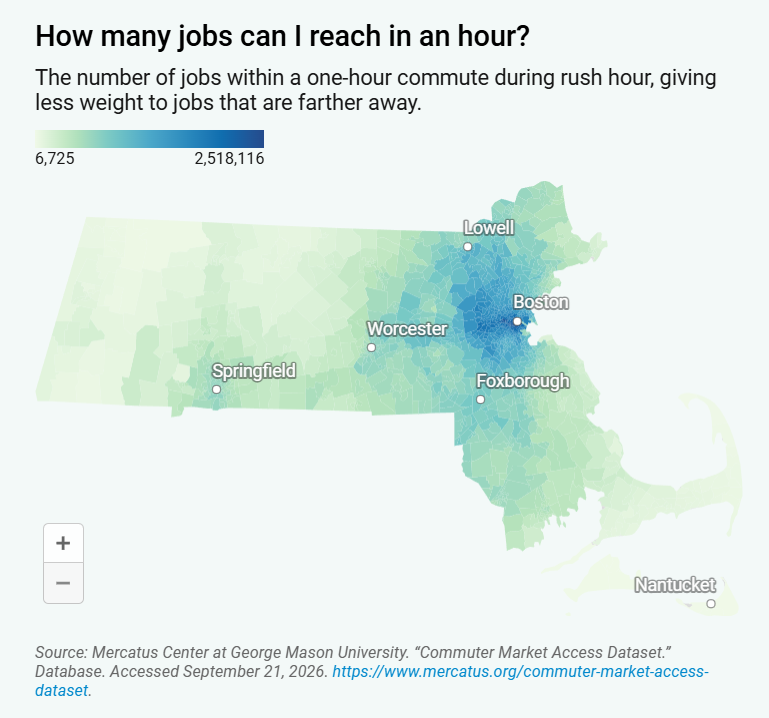
It was well-timed: it seemed like the conference featured dozens of papers with QSMs, and the first keynote lecture, by Stephen Redding, covered the basics of the QSM. Many of the other papers reviewed in this post use a QSM even if I don’t mention it.
Amy Min Zhang explores the effects of regulation on pollution in general equilibrium. Even nationwide regulatory changes can have bigger impacts in higher-regulation areas. The 1991 Clean Air Act amendments caused a shift in heavy industry from the Rust Belt to the less-regulated South. Using a quantitative spatial model, she finds that the regulation cost 0.2 million jobs nationwide, but reallocated 0.4 million jobs from high- to low-regulation regions. (What was less clear in the presentation was whether firms in the low-regulation areas could somehow evade the federal requirements or if the issue was the interaction between federal and state regulation. She also did not incorporate an international dimension, but it seems very likely that jobs also leaked overseas.)
Frederic Robert-Nicoud, Pierre-Philippe Combes (presenting), Gilles Duranton, and Laurent Gobillon offered one of the only theory papers of the conference, a new workhorse model (they hope) that improves on the popular QSM framework by introducing non-homothetic housing demand.
The fundamental tradeoff of urban economics is between agglomeration benefits and crowding-and-commuting costs. But if people can sufficiently economize on housing by living in smaller and smaller dwellings, then the models predict that every city will either grow infinitely or shrink to zero.
The authors’ contribution is to make housing a necessity while keeping the model tractable. Now, when a city’s size increases and both prices and wages rise, the necessity effect forces people to spend a larger share of income on housing. That is, the costs eventually outweigh the benefits. In a system-of-cities model, this allows every city to continue existing at some level of population.
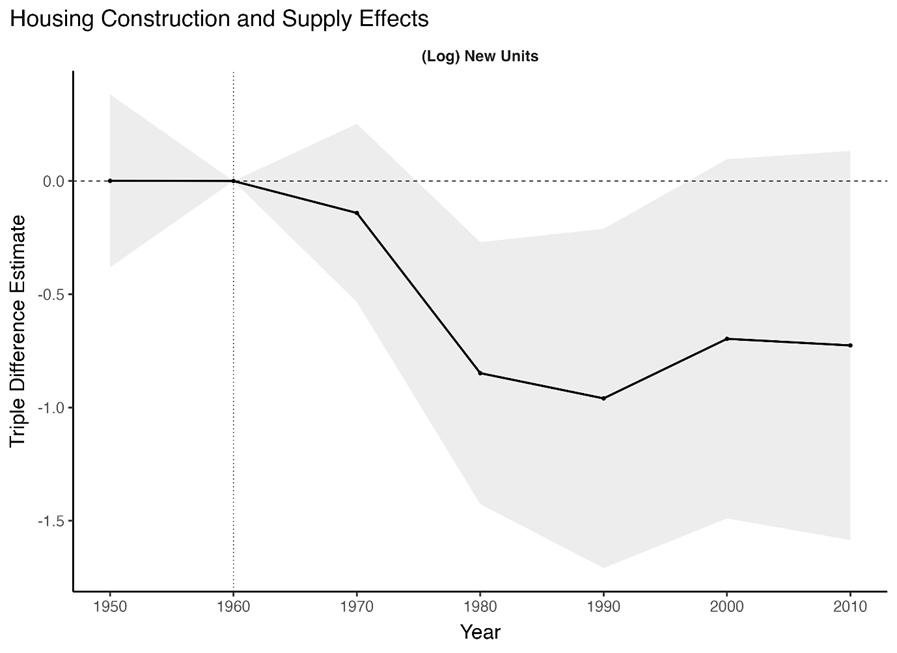
Tom Cui (presenting) and Beau Bressler look at the effects of a major urban planning effort from the 1960s. “Section 701” brought federal dollars to a large percentage of small cities – but those above 50,000 in population were ineligible. The authors have a tricky time generating precise estimates because the total number of cities is modest – so they can’t just use the obvious empirical strategy of comparing those just above & below the boundary. But they use variation in state enthusiasm for the program within Census regions (Alabama was eager, Texas was indifferent) to generate triple-difference estimates.
They find that receiving planning assistance generated a huge, negative effect on housing growth in the 1970s and 1980s, continuing (but with less precision) into the 2000s.
And this wasn’t because the planners were promoting smart growth: the drop in permitting is concentrated in multifamily housing. It also increased the use of value capture policies. The authors interpret the findings as local adoption of a “regulatory innovation” that more efficiently converted local NIMBY preferences into policy.
Jacob Herbstman tries to suss out the effects of Chicago’s aldermanic privilege on housing supply. Aldermen exercise extreme discretionary regulatory power within their wards. Until Lori Lightfoot was elected, each alder received a nightly (!) email with all the building applications in his ward.
Herbstman uses 2015 redistricting as a boundary/event study, using city blocks that were redistricted as the treatment group. He finds that shifting to a more-strict alder decreases permitting in those blocks by 20%. However, standard errors are large for all his estimates.
Overall, I’m not completely convinced by the experiment. The districts are racial gerrymanders, and the alder’s race may be correlated with strictness. Blocks that are redistricted are more likely to be those that have undergone racial change or to be a mismatch with one alder’s race, which probably impacts the supply or demand for permitting in other ways. This is a case where the empirics are less valuable than gaining a rich qualitative understanding of the underlying phenomenon. Even if aldermanic privilege was proven to have zero net effect on permitting, it would be objectionable on the grounds of fairness and corruption.
Desmond O’Shaughnessy presented one of the papers by The American Zoning Project (headed by Alex Bartik and Arpit Gupta). The team has collected 3,600 historical zoning codes from 2,500 cities, and is in the process of digging up more. They find that codes have become more flexible over time with respect to use, but stricter with respect to parking and procedure and more extractive in terms of value capture. One historic episode they note is a 1950s push by industries to replace rigid zoning lists with measurable performance standards for industrial zones.
They have committed to making their data fully public.
Steph Kestelman revealed negative research about a zoning program from Los Angeles: although the Transit Oriented Communities caused a big increase in applications, it did not lead to an increase in completions. It did nudge some production to neighborhoods where it is more difficult to build (in the upside-down world of LA, that means lower-income neighborhoods, where anti-gentrification sentiment makes it difficult to build apartments).
The surge in applications was largely explained by developers filing incomplete, quickie applications that were placeholders for later consideration. The lack of a building response, according to developer interviews, is that the density bonus offered by TOC was not enough to offset the deep affordability requirements.
It will be interesting to see if new zoning forced by SB 79 finally breaks open LA’s stingy zoning near transit stations.
Suvy Qin studies how city personnel impact approval processes for building plans, also in Los Angeles. Plan review in Los Angeles averages 300 days (and the standard deviation is also 300 days), almost all of the time spent in back-and-forth between checker and applicant.
On average, the city can hire better plan checkers during economic downturns, allowing Qin to exploit timing as plausibly exogenous variation. Those better plan checkers sign up for more overtime, complete more reviews, and have equal quality outcomes to the control group. For the city, it would be economical to offer higher wages in order to attract better plan checkers. My own view: it would be even more economical to reduce the stringency of plan checking.
Another theme of the conference is the enormous quantity and quality of detailed data that researchers can throw at questions big and small. Even Ph.D. students are now writing papers with propriety datasets. Where a quantitative case study was considered pretty good a decade ago, a part of proving your chops as a student is to assemble the most comprehensive data on your topic.
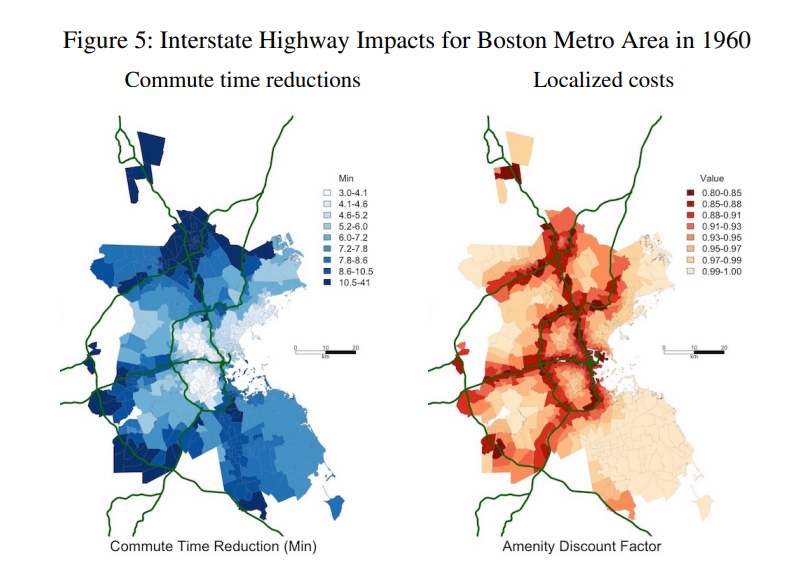
She’s now a professor at Cal, but the most unlikely student-data story might be from Laura Weiwu, who apparently discovered data on a neglected Census Bureau server allowing her to link 57 million children born in the 1960s and 70s to their parents in tax records. Given the era, she asks how the expansion of highway systems affected income mobility. Using a QSM, she finds that new interstate highways benefit upward mobility: doubling the commuter market access in parents’ locations increases children’s future incomes by 30%. But the benefits were not shared by Black families, because they were excluded from many of the suburbs that became accessible via interstate construction. She uses a formal model to show that, in the absence of segregationist barriers, Black families would also have benefited.
Michael Neubauer (presenting) and Gabrielle Grafton ask what happened to those left behind during the Great Migration? It’s a great question, and they have a clear answer: wages rose, visible racism decreased, and some farms closed. A 1 percentage point increase in Black emigration led to a 4% increase in wages for Black stayers and a 2% increase in wages for White stayers.
The challenge for studying something like this is that the selection effect is intense. Who migrates and who stays depends on their personal characteristics, and the rate of migration depends on both push and pull factors. They try to deal with individual selection by limiting their study to people with characteristics that make them very unlikely to migrate (e.g., older people). And they try to deal with the endogeneity of the migration rate by isolating pull factors in places with strong migration links.
However, as some attendees pointed out, it’s likely that places with strong migration links are also likely to have other economic links. So the authors have more work to do to convince readers that their approach is really isolating the effect of outmigration.
Kaan Cankat (presenting) and Allison Green try to understand how important was the ability of central cities to annex land during the 20th century suburban boom. They used a staggered diff-in-diff and instrumental variables, both of which I found unconvincing. If you believe their results, they get a decrease in the per-capita costs of some city services (like firefighting) while other costs (like sanitation) stay constant or rise slightly. Overall, the effective property tax rate declines 2.5%. If these results are right, the suburbs (especially when brand-new) were subsidizing the city. There’s also some role for economies of scale: fewer fire stations, but with a higher ratio of engines (expensive) to trucks (cheaper).
Speaking of city lines, Colin Williams, a runner-up for the student prize,documents that HUD Code manufactured homes are much more common outside municipal boundaries than inside. He uses the entire USA – except New England, which has few unincorporated areas.
Evan Soltas (presenting) and Allan Lee find a catastrophic decline in the efficiency of Low Income Housing Tax Credits (LIHTC): “real construction costs rose 80 percent from 2013 to 2024, holding fixed project size and location.” They can’t fully explain why; rising complexity is one candidate.
Beau Bressler built a database of all US public housing, including resident characteristics at the building level. With this level of detail, you’d hope to uncover invisible insights. But his conclusions are mostly in line with the conventional wisdom on public housing:
Dionissi Aliprantis (presenting) and Stefanie DeLuca (and maybe a third author named Park?) try to understand why the Baltimore Regional Housing Partnership (BRHP) was so much more successful than the similar Moving To Opportunity (MTO) program. Both are premised on giving housing vouchers to people who are poor and mostly Black and nudging them to move to better neighborhoods. MTO gets praised a lot for having benefits for younger children, but its outcomes for older children and adults are mediocre and the MTO moves often took people to only slightly-better neighborhoods. BRHP, on the other hand, resulted in a huge change in neighborhood type. The typical BRHP resident went from a 3rd-percentile census tract to a 71st percentile tract! By contrast, receiving a housing choice voucher typically moves people from the 4th to the 21st percentile.
The authors identified two reasons why BRHP was so successful. The first is that the worst Baltimore neighborhoods are in extremely bad shape. The bottom 10% of regional neighborhoods (they constructed a composite measure of neighborhood socioeconomic status) contain 30% of the region’s Black population:
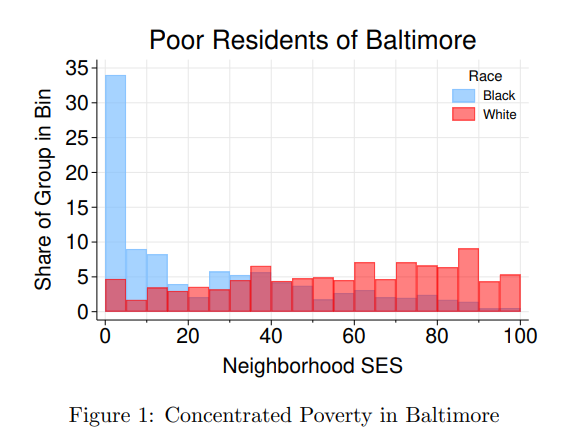
With disadvantage and segregation so extremely aligned, it’s not hard to find improvements.
The second reason, and the one that dominates statistical analysis, is that BRHP was regional in design and intent – after all, it was the result of a court order to address segregationist policies in suburban Baltimore County. Fully 2/3 of the improvement in neighborhood quality is accounted for by cross-border moves: people leaving Baltimore City for the county. This finding implicitly damns the non-portability of Housing Choice Vouchers.
Aliprantis recommended the book Waiting for Gautreaux, a first-hand account of the similar highly successful, court-ordered voucher program in Chicago. Another book that’s great for understanding the Baltimore story is Lawrence Lanahan’s The Lines Between Us.
Elior Cohen looked at what happens in Los Angeles when a new homeless shelter or rehousing site is opened. From 2014 to 2024, homelessness rose by 33% while the number of beds rose by 54% – to the point that there are more shelter + rehousing beds in the system than homeless people in the PIT Count. In the most recent PIT count, 83% of LA census tracts had at least one unsheltered person.
A surprising feature of his data was how often sites closed; my assumption was that once a site came online, it lasted for decades.
Using an event study framework, he found very different effects of shelters versus permanent beds.
There’s no great takeaway here unless you’re looking for evidence to oppose housing for homeless people in your neighborhood.
Emily Merola also studied homelessness, but in Seattle. She looked at encampment closures using a diff-in-diff with matched comparison group designed to avoid spillovers. Again, it’s all depressing. About half of closures are repeats (the city clearing a location it had cleared not long before…the median time between repeats is 136 days). She has promising data – cell phone pings to measure foot traffic, police and city service calls, but ultimately finds muddy evidence. Public service requests at the cleared site decline, but they rise by even more in nearby areas. Crime declines at the site, but then rebounds.
Jens Ludwig, author of Unforgiving Places, gave a keynote lecture on US gun violence. For a conference occurring in the City of Big Shoulders, it was a worthy homage to the influence of Chicago School sociology on economics. His decades of work with Chicago neighborhoods and police have convinced him psychological work is the key to reducing gun violence: “78% of gun homicides are arguments settled with guns.” Methodologically, he sees “too much Becker and Friedman and too little Richard Thaler” in economists’ treatment of crime.
While I have no critique of the specific interventions he likes (such as training adolescents to deal with conflict), the macro story left me unconvinced. I think one questioner pointed out that there’s no time series in “System I” versus “System II” thinking. And while gun-use may normally occur in a moment of passion, gun-acquisition requires some forethought.
Ludwig agrees that magically removing all guns would stop most homicides, but points out how politically impossible that is. It seems to me that convincing every poor, disaffected adolescent to submit to intensive conflict-management training is almost as impossible. Nevertheless, many cities have experienced large increases or declines in murder rates. There are “easy” sources of variation well within the political norms.
The City of Chicago was also a highlight. The day before the conference was my own Ferris Bueller’s Day Off, complete with a Cubs game (the Cubbies clinched a playoff berth and Pete Crow-Armstrong entered the 40-40 club), beer gardens, and gracious local hosts who took time out of their days to show me some of their favorite aspects of the city.