Physical Address
304 North Cardinal St.
Dorchester Center, MA 02124
Physical Address
304 North Cardinal St.
Dorchester Center, MA 02124

Liberalizing Cities
From The Ground Up
If the 2010s were the decade that urbanists “discovered” zoning as a major force in American cities, the 2020s are the decade of discovering all the non-zoning restrictions and regulations that restrict housing construction and urban change, especially building codes and permitting processes.
Another type of restriction that deserves attention is deed restrictions. Although El Paso, Texas, has fairly permissive zoning and new state preemptions that legalize residential in commercial zones and small-lot subdivisions of 5-acre+ parcels, those permissions cannot be used on the huge swath of commercial and residential land restricted by deed.
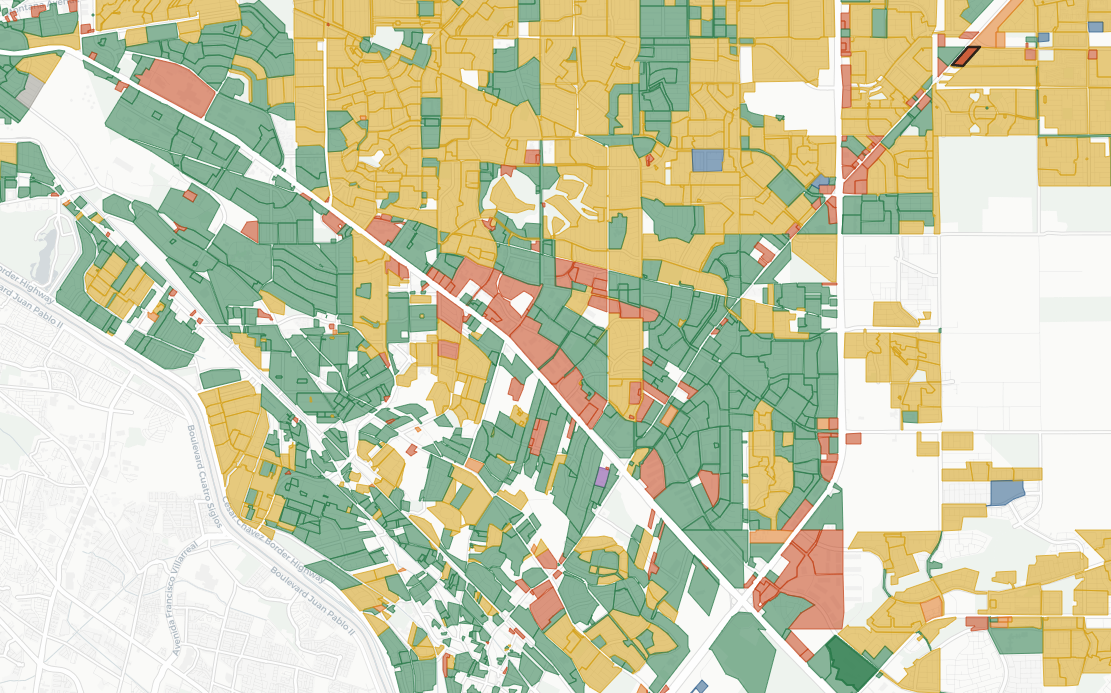
Alex Hoffman, an urban planner at the City of El Paso, mapped out deed restrictions in the city – yielding a map of rigidities that looks suspiciously like a zoning map. Alex even found 5.5 acres restricted to quadplexes only: no triplexes or five-plexes, thank you very much!
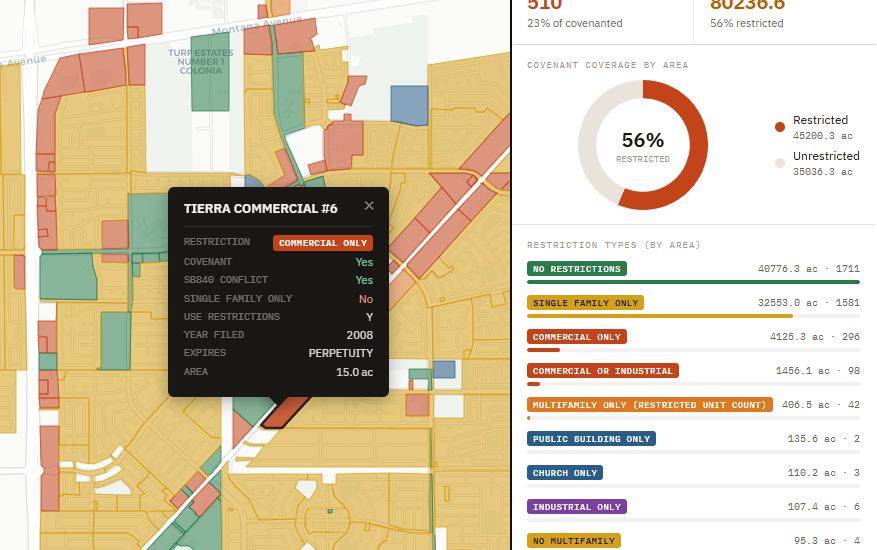
Even in neighborhoods where single-family, multifamily, commercial, and public uses exist alongside each other, most of those uses are locked in by deed.
There’s a range of reform options for deed restrictions, including some combination of the following:
Personally, I favor putting time limits on deed restrictions. This comports with the longstanding jurisprudential “rule against perpetuities”: no generation should be allowed to lock up the future. And unlike entirely canceling or banning deed restrictions, it allows most of their positive features – especially predictability in the development process – to work while eliminating most of their negative features (locking in land uses that have become sub-optimal).





Agree Salim; sunset clauses would be good. This is a problem happening worldwide.
Another option might be to have a mechanism that manages a wider area’s covenants down towards expiring them, like a special purpose urban development authority. Eg, a sufficiently large petition could trigger a public assessment of whether the collective land value might increase if a set of covenants across the area were ultimately removed.
I’m inspired here by the ‘enclosure acts’ initiative that this article argues triggered the industrial revolution: https://worksinprogress.co/issue/how-abolishing-the-stakeholder-state-caused-the-industrial-revolution/. I’m not suggesting the plots get reassembled and then divvied out again though — I’m suggesting that the private property rights get augmented for the greater good of the set of property owners collectively.
The required petition could be designed to prevent tyranny of the majority landowner and against tyranny of the minority landowners; eg a sufficient share of consent by land value and consent by the number of deeded properties. And perhaps the larger the share of consent across both groups, the stronger and swifter the public authority’s response