Physical Address
304 North Cardinal St.
Dorchester Center, MA 02124
Physical Address
304 North Cardinal St.
Dorchester Center, MA 02124

Liberalizing Cities
From The Ground Up

A correspondent asked me recently if other governments should imitate the Australian Capital Territory (ACT) and enact charges or taxes to extract most of the value of land lift when government approves a change to a more-intense use of land. (In Canberra, there’s a double system of zoning plus parcel-specific lease terms which restrict land use. The lease change triggers the land lift tax. In practice, there are lots of complications.).
The ACT system, however, is grounded in a flawed notion that the incentive role of prices can be separated from the wealth role of prices. Because all ACT land is owned by the government, the theorists behind its land rules think that all land wealth should be returned to the government. But this neglects the fact that without wealth to be gained from land, the incentive to use land efficiently is lost. Property ownership is a chair, and trying to divide use decisions from the value of use makes it a wobbly one.
For any individual redevelopment project, the economics are blurred by idiosyncrasies: at any given moment, redevelopment would be very inconvenient for most property owners, so they don’t do it. But there’s a ground truth underneath the haze: only properties where redevelopment is profitable will redevelop.
Imagine a location with 100 properties on identical land. Five are unimproved. Their value is exactly equal to a developer’s break-even profit from development under current zoning. So in the long run, 5 parcels will be developed.
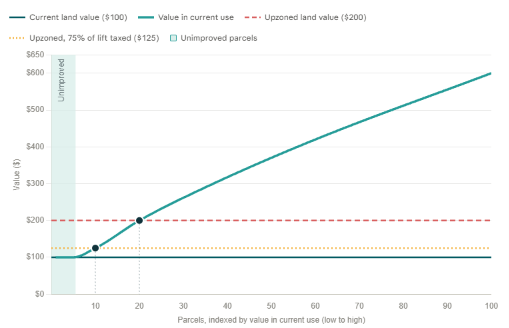
Now imagine that the land is upzoned, or that an upzoning is offered to anyone who wants it. An owner can now develop to an intensity that yields a net present value of $200 per parcel instead of $100 (though there aren’t always big gains from upzoning). So the 20 parcels which were worth less than $200 in current use are now worth redeveloping.
But what if parcels that redevelop are required to refund 75% of their land lift? Then the land is worth only $125. Because the land lift tax only applies to redeveloped properties, parcels where the current use is worth $125 to $200 are no longer worth redeveloping. They make more money in current use than they would by redeveloping, getting $200, and paying $75 back to the government.
Removing an artificial restriction on land use isn’t the same as creating new value via investment. So it’s rather generous to call the value released by upzoning “land lift”. More accurately it would be something like, “cessation of land depression.” I’m much more interested in requiring governments to compensate landowners for new restrictions on land use.
There are certainly times when government investment creates land value and the cost of the investment should be borne by the beneficiaries. London’s Elizabeth Line was primarily funded by a tax on Greater London businesses. To be sure, this stretched the definition of ‘beneficiary’ beyond the directly relevant geography. But, crucially, the businesses had to pay regardless of whether they redeveloped, so the distortion on their decisions was much smaller. (London also had a small tax on new floorspace, which was distortionary).
Property taxation as practiced in the US is a similar way to partially extract value from new development with less distortion. When interest rates are 5%, a 1% annual property tax on new development would be like a 20% land lift tax. But property taxes aren’t just applied to new developments. They reduce the value of existing uses as well, so the distortionary effect is much smaller.
Land taxes can theoretically go even further toward non-distortion. This is a post for another day, but my view is that land taxes pose much greater administrative difficulties than property taxes and could be harmful, on net, in places that practice zoning.
Other compensation schemes are based on politics rather than philosophy. A colleague of mine has proposed that part of the upzoning land lift be used to compensate NIMBY neighbors who bear some disruption costs from development. That’s Coasean, which is nice, but it also invites extraction – how is one to measure psychic costs from neighborhood change?
My correspondent was curious about land lift taxes not because he believes that the “ultimate fee to land reposes in the state“, but because he wants a political path to pro-growth consensus. In 2016, this idea would have had significant merit. The firm consensus was that well-organized NIMBYs could never be overcome. And that was true until it wasn’t. The political success of direct, uncompensated YIMBYism, from Auckland to Melbourne to Edmonton to Montana – and the unimpressive results of “compromise YIMBYism” in some California and Maryland laws – suggest that the best approach is the direct one: We should allow more growth because growth is good for us.