Physical Address
304 North Cardinal St.
Dorchester Center, MA 02124
Physical Address
304 North Cardinal St.
Dorchester Center, MA 02124

Liberalizing Cities
From The Ground Up
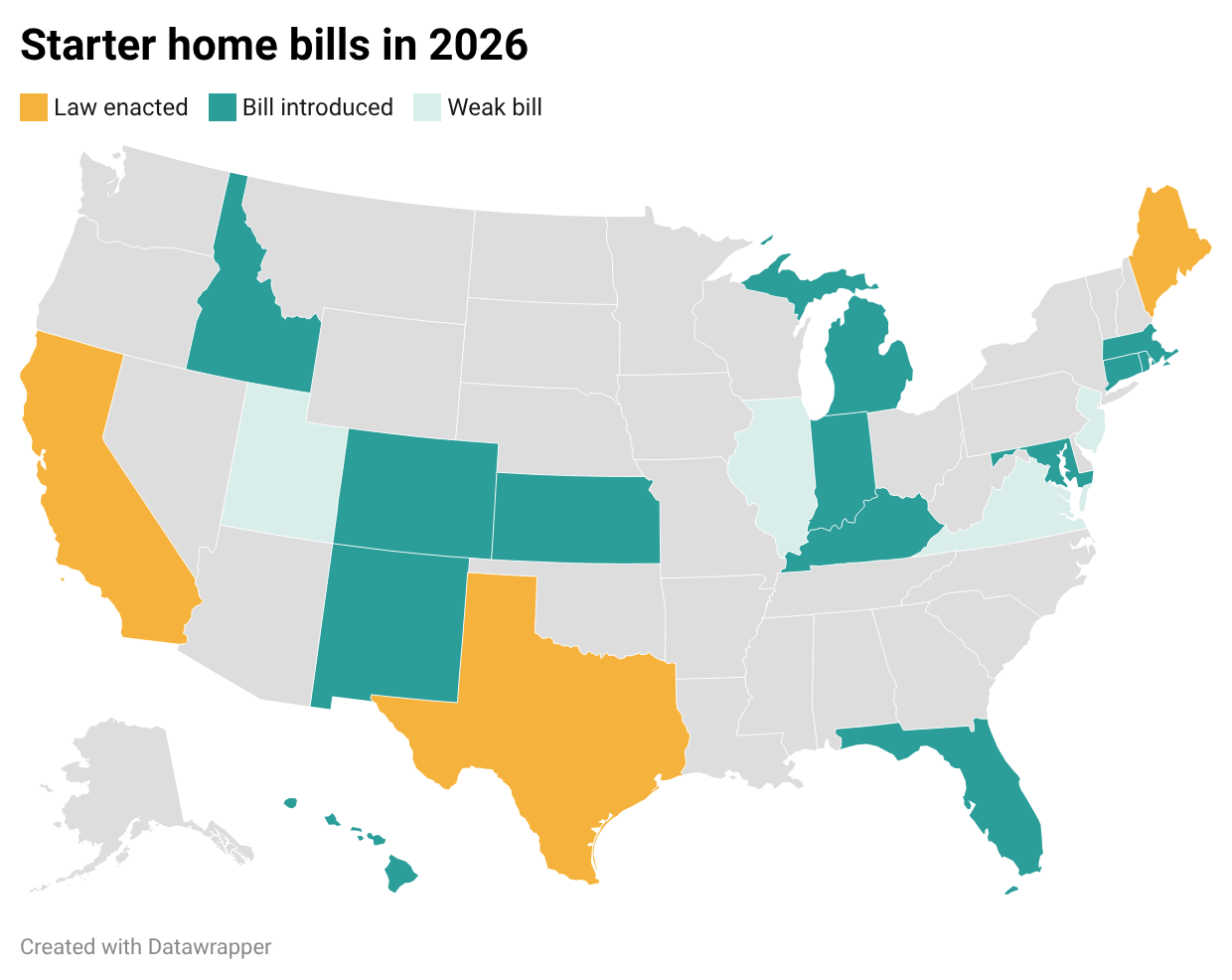
Updated 2/19 to add Michigan, 2/17 to add Kentucky, 2/16 to add Idaho, 2/11 to add Connecticut; 2/5 to add Colorado; and 1/30 to add Hawaii, Kansas, New Mexico, and Rhode Island.
After decades of background study and advocacy – see here for a research compilation – legislators in Maine and Texas passed bills that allow starter homes by putting guardrails on local minimum lot sizes. Without guardrails, localities often require every new house lot to be much bigger than what local families can afford.
California took another approach, allowing small developments of up to 10 starter homes statewide under specific parameters. I don’t know of any data yet, but Californians tell me this is much more successful in generating new home starts than other, higher-profile reforms the state has passed.
With those successes, several more states have serious proposals on the table for 2026. Here’s a brief comparison, emphasizing the lot size that’s required under the law, where the law applies, and whether the law has detailed protections against local poison pills.
The “detailed protections” are important because it’s very easy to shadowban small lot homes via large setbacks, width or depth requirements, and so on.
| Lot area | Applicability | Detailed protections | |
| California law (2021-24) | (a) 600 sq ft (b) 1,200 sq ft | (a) Sites of <5 acres in multifamily zones (b) Vacant sites of <1.5 acres in single-family zones | Detailed parameters both protecting and limiting the use of the law. Allows only 10 homes per development. |
| Maine law (2025) | (a) 5,000 sq ft (b) 20,000 sq ft | (a) access to public water & sewer (b) all other | Awaiting implementing regulations |
| Texas law (2025) | 3,000 sq ft | Unplatted sites of 5+ acres in cities>150,000 within counties>300,000 | Width, depth, setbacks, height, bulk, parking, open space, etc. |
| Under consideration: | |||
| Massachusetts ballot measure | 5,000 sq ft | Access to public water & sewer | Width (50 ft) |
| Massachusetts YIMBY Act | No minimum lot size | Universal | None |
| Indiana HB 1001 | (a) 1,400 (b) 1,500 (c) 5,445 | (a, b, c) Connected to water & sewer (b) originally townhouses, amended to duplexes (c) single-family | Width, setbacks, FAR, coverage. (a) Towns may opt out. |
| Florida Starter Homes Act | 1,200 sq ft | Public water or sewer | Width, setbacks, coverage, height, FAR, etc. |
| Maryland Starter & Silver Homes Act | 5,000 sq ft | Public water & sewer | Setbacks, coverage, home design, etc. |
| Kansas By-Right Housing Development Act | 3,000 sq ft | Universal for homes up to 3,000 sq ft interior space | Setbacks (vaguely) |
| Hawaii SB 2423 / HB 1734 | 1,200 sq ft | Urban district land subject to some exceptions | Width, depth, setbacks, parking, coverage. Allows neighborhood opt-out. |
| New Mexico HB 138 | No minimum lot size | Universal | None |
| Rhode Island S 2265 | (a) 2,500 sq ft (b) 5,000 sq ft (c) 1 acre | (a) Within 1/4 mile of a transit stop (a & b) Served by public water & sewer (c) all other | None |
| Colorado HB 26-1114 | 2,000 sq ft | Wherever infrastructure standards can be met | None. Local implementation by 2031. |
| Connecticut SB 151 | 5,000 sq ft | Public water & sewer | Size, lot coverage, setbacks, design |
| Idaho S. 1279 | 2,100 sq ft and 12 units per acre | Undeveloped 4-acre parcels, subject to topography, enviro, and infrastructural constraints | Preempts new HOAs. Setbacks, width, depth, fees |
| Kentucky HB 617 | 3,000 sq ft | Sites of 5 acres in cities>10k and counties>15k | Width, depth, setbacks, height, bulk, parking, open space, etc. |
| Michigan HB 5530, HB 5529, and HB 5583 | 1,500 sq ft | Public water & sewer | Setbacks (in 5583) |
Some interpretive points:
It may be impossible to legislate minimum lot size guardrails that clever local regulators can’t sneak around. But I’m impressed with the thoughtfulness and quality of these bills. Removing excessive requirements for new homes is a key step to enabling starter homes in more places.
Honorable mentions: Illinois, New Jersey, Utah, and Virginia have bills which would gently nudge localities to allow starter homes but without enough compulsion or incentive to be likely to work. Vermont’s 2023 HOME Act was the first clean minimum lot size preemption, but at 5 units per acre (8,712 sq ft) it doesn’t make the cut for ‘starter home.’